
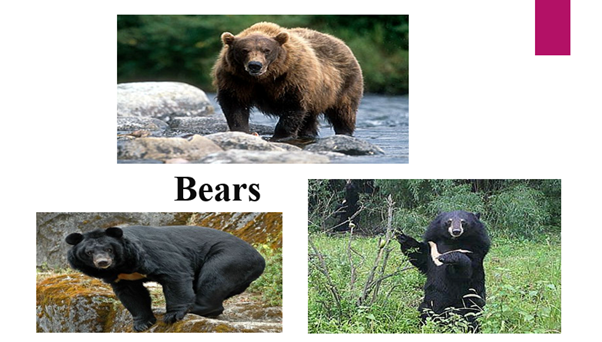
Baluchistan Black Bear—Ursus thibetanus gedrosianus
- Also known as Mum
Status:
Critically endangered - Habitat: Higher ranges of the province of Baluchistan in southwest Pakistan and southeast Iran. The major stronghold in the Pub Range (Khuzdar Hills), where it is mostly confined to arid sub-tropical thorn forest
- Distribution:
It is abundantly present in the Khazdar district of Baluchistan. Persisted in the Suleiman range, the Toba Kakar range, and Kalat.
Morphology
- Baluchistan bears have a cream-colored crescent patch on their chests.
- Thinner head
- flanks branching from its head
- Size: 55 to 75 inches
- Weigh between 200 and 400 pounds.
Diet
- Baluchistan bears eat green plants, fruits, berries, seeds, honey, and insects.
- It also feeds on small vertebrates such as birds, rodents, and lizards.
Breeding Biology
- Females mature between three and four years of age.
- Mating reportedly occurs in October.
- Gestation period: 7-8 months
- One to three cubs in February.
- The cubs are born blind and totally dependent on their mother. They are weaned at about six months but remain with their mother for two to three years. The natural lifespan is 25 to 30 years.
Importance
- Balochistan black bears break up downed logs in their search for grubs, helping the process of decay in the forest and the return of nutrients to the soil.
- Gallbladders for medicines.
Threats
- Deforesting and overhunting
- killing by herders
- Lack of awareness about the Balochistan black bear
- Capturing/trapping bear cubs for baiting & dancing
- The species has not yet been explored & studied properly
- Poaching for pets
- Local and nomadic herders let their cattle graze in the bear territory
Conservation
- BRC
- WSPA
- WWF-Pakistan
- Baluchistan Black Bear is protected by legislation in Baluchistan Province
- Convention on International Trade in Endangered Species of Wild Fauna and Flora (CITES), banning all international trade of any products derived from the species.
Himalayan Black Bear – Ursus thibetanus laniger
- Status: Vulnerable
- Habitat: Found in the forests of Azad Kashmir, Khyber Pakhtunkhwa, and Kohistan. Nocturnal to avoid humans. They often spend the day in caves or hollowed-out trees
- Distribution: Mainly confined to the Himalayan moist forests of Pakistan and occurs in the Neelum valley of A&JK, Kagan valley in Hazara District, and in Chitral, Diamir, and Kohistan
Morphology
- A black coat with a light brown muzzle and a pale yellow crescent on its chest.
- On average, they measure from 56 to 65 inches nose to tail
- Weigh from 200 to 265 pounds
Diet
- Their diet consists of acorns, nuts, fruit, honey, roots, and various insects such as termites and beetle larvae.
- If food is scarce, they may turn to eating livestock such as sheep, goats, and cattle.
Breeding Biology
- Sexual maturity is reached at approximately three years.
- Mating is believed to occur in October, with usually two cubs born in February while the mother is still hibernating
- The offspring usually stay with their mother into the second year
Importance
- The cub was being sold for 330,000 at Dr. Rana’s Pets Care Centre stall at the National Science Fair
- Bears as skin products:
- Fur coats, jackets, stoles, shawls, earmuffs, handbags, headbands
- purses, gloves, hats, blankets, and carpet.
- Bear’s Fat value:
- Massage on bones and joints for relief of pain
- sold to outside dealers
- Bear gallbladders as a medicinal value :
- To stimulate sexual potency
- Treatment of life-eating cancer
- Burns, pain, redness of the eye, and asthma
- Treat liver ailments
Threats
- Habitat Loss
- Competition with livestock
- Cub poaching
- Illegal hunting for body parts, specifically the gall bladder, paws, and skin
- Encroachment of the human population
- Forest fires, and the timber industries
Conservation
- BRC WS is supported by WSPA
- Bear WS in Chakwal
- WWF
- Himalayan Jungle Project in 1994
Himalayan Brown Bear—Ursus arctos isabellinus
- Other names: red bear, snow bear
- Status: Critically endangered but Vulnerable globally
- Distribution:
- 17 to 75
- persist in the Himalaya, Karakoram, and Hindu Kush ranges, Kalam, Neelam valley
- in northern latitudes such as northern Chitral, Ghizer, Gilgit, and Skardu.
- From 15 localities as Deosai, Minimerg, Nanga Parbat, Central Karakoram National Park, Khunjrab National Park, Ghizer, Karanbar, Tirch Mir, Kalam, Palas, Kaghan, Gumot, Shontar, and Taobat.
Morphology
- Males range from 1.5m up to 2.2m (5 ft – 7 ft 3 in) long
- Females are 1.37 m to 1.83 m (4 ft 6 in – 6 ft) long.
- They are the largest animals in the Himalayas
- Usually sandy or reddish-brown in color.
- with a big head, small eyes, and stocky limbs
Diet
Mostly vegetarian, feeding on herbs and grasses, rodents including rats, squirrels, hedgehogs, marmots, and fish.
Breeding Biology
- mate from May to July,
- A gestation of 180 to 266 days
- Births occur from January to March, usually while the female is still in hibernation.
- She generally lays down two to three offspring and breeds again 2 to 4 years later.
- Brown bears can reach 20 to 30 years of age
Importance
- Powerful medicinal value
- Used in research Studies
- Bears as a food source:
- Hunted for their meat, and their paws are eaten as a delicacy.
- As food: not directly eaten but by feeding the fat of the bears to birds, particularly roosters, then eating those birds
- Bears as pests: Regarded as pests and persecuted in some areas, as they can destroy crops
Threats
- Growing human population
- Expanding infrastructure, increasing number of livestock
- increasing dependency on natural resources particularly alpine pastures
- Poaching for its commercial parts and for cubs
- Growing unmanaged tourism
- bear baiting events
- habitat loss and fragmentation
Conservation
- BRC support by WSPA
- WWF
- Himalayan Wildlife Project later renamed Himalayan Wildlife Foundation (HWF)
- management of natural resources
- Seven national parks and many wildlife sanctuaries and game reserves,which provide legal protection to bears
- Environmental education need immediate attention. Bear baiting is illegal under Prevention of Cruelty to Animals Act of 1890