

Fatty Acid Activation
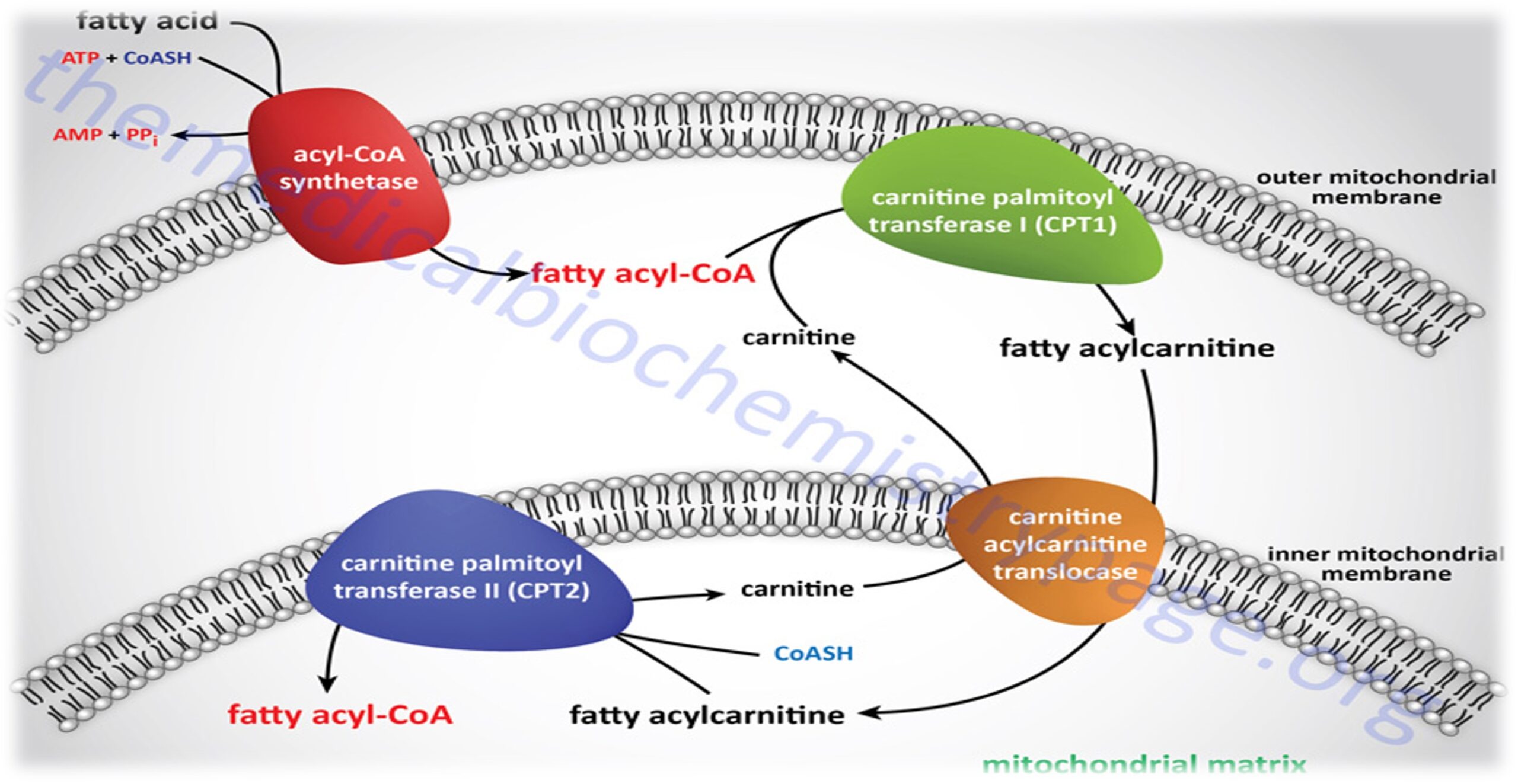
Fatty acid activation occurs in the cytosol, but fatty acids are oxidized in the mitochondria.
Enzymes of Fatty acid activation
- Acyl CoA ligases (thiokinases).
- Inorganic pyrophosphatase.
Steps involved in fatty acid activation
- Formation of Acyl-CoA
- Exergonic hydrolysis of PPi
Formation of Acyl-CoA
- There are different Acyl-CoA Synthases for fatty acids of different chain lengths.
- It is associated with endoplasmic reticulum membranes and the outer mitochondrial membrane and catalyzes the activation of long-chain fatty acids, esterifying them to a coenzyme.
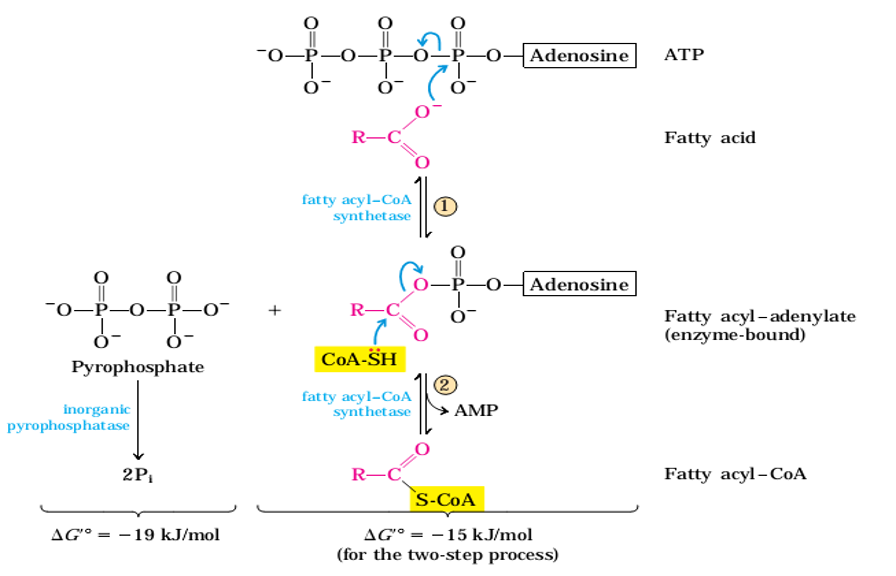
- Adenosine triphosphate (ATP) drives the formation of a thioester linkage between the carboxyl group of a fatty acid and the sulfhydryl group of CoA.
Exergonic hydrolysis of PPi
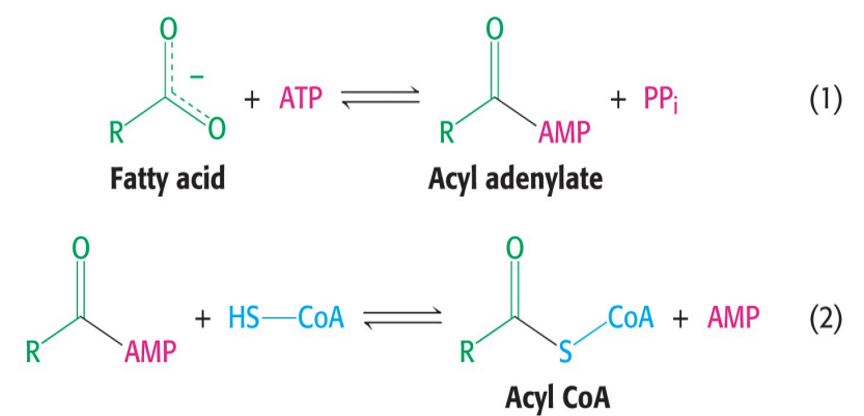
- Paul Berg showed that the activation of a fatty acid is accomplished in two steps.
- First, the fatty acid reacts with ATP to form an acyladenylate.
- The carboxyl group of a fatty acid is bonded to the phosphoryl group of AMP. The other two phosphoryl groups of the ATP substrate are released as pyrophosphate.
- The sulfhydryl group of CoA then attacks the acyl adenylate, which is tightly bound to the enzyme, to form acyl-CoA and AMP.
- The acyl-coenzyme A product includes one “high-energy” thioester linkage
Fatty Acid Transport Into Mitochondria
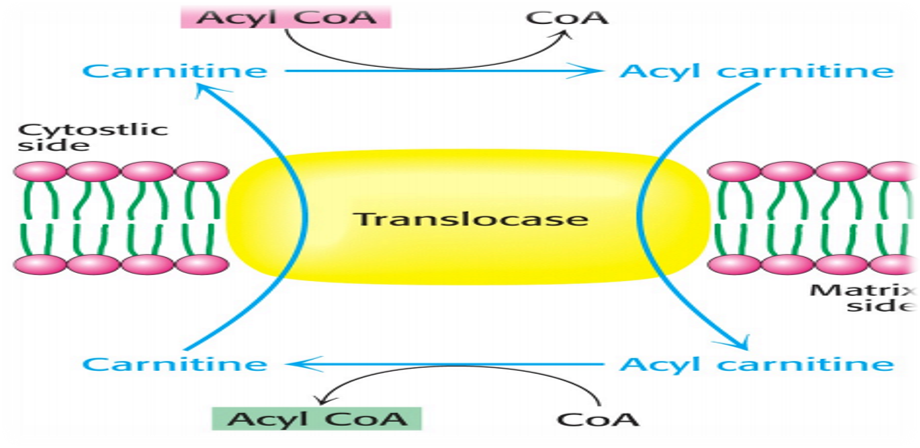
Carnitine takes long-chain fatty acids into mitochondria through a special transport system as a carnitine shuttle.
Carnitine
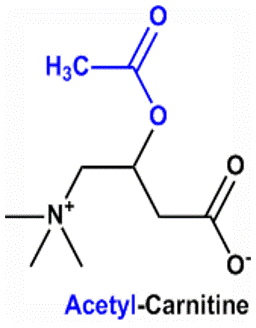
- Carnitine, derived from an amino acid, is found in nearly all cells of the body. Its name is derived from the Latin word carnus, meaning “flesh”.
- Carnitine plays a critical role in energy production
- It transports long-chain fatty acids into the mitochondria so they can be oxidized (“burned”) to produce energy.
- Carnitine is concentrated in tissues that utilize fatty acids as a dietary fuel.
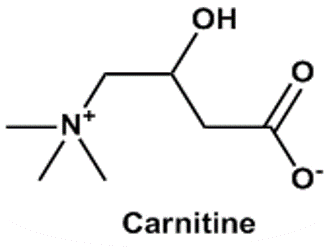
- The carnitine shuttle transports long-chain fatty acids across the barrier of the inner mitochondrial membrane to access the enzymes of beta-oxidation.
- The carnitine shuttle consists of three enzymes:
- carnitine palmitoyltransferase 1 (CPT1A & CPT1B)
- Carnitineacylcarnitinetranslocase (SLC25A20)
- Carnitine palmitoyltransferase 2 (CPT2)
- Carnitine
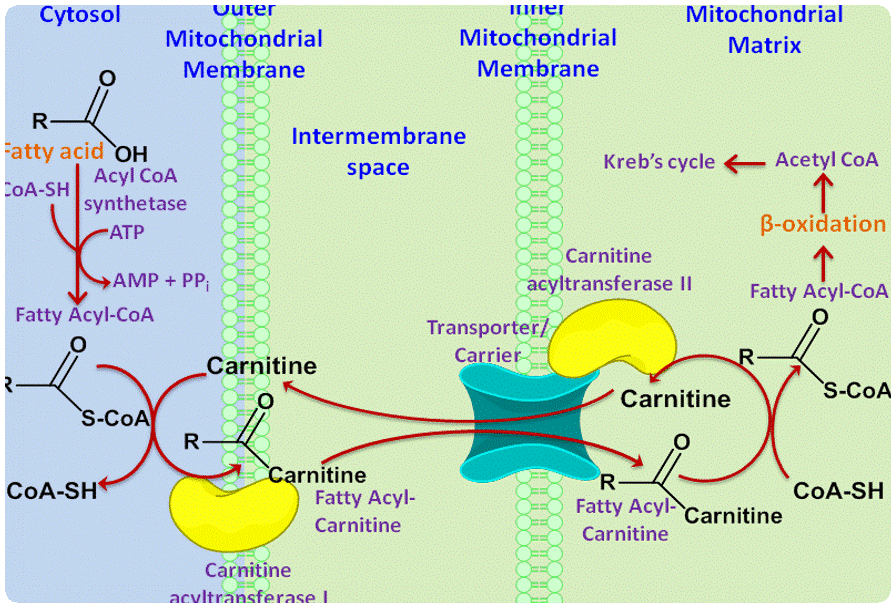
Enzymes Involved in Transport of Fatty acids
- Enzymes specific for very long-chain fatty acids are associated with the inner mitochondrial membrane, facing the matrix
- Carnitine Palmitoyl Transferase I: Catalyzes the transfer of a fatty acid from ester linkage with the thiol of coenzyme A to the hydroxyl on carnitine.
- Carnitine Acyltransferase: Mediates trans-membrane exchange of fatty acyl carnitine for carnitine.
- Carnitine Palmitoyl Transferase II: Catalyzes the transfer of the fatty acid from carnitine to coenzyme A
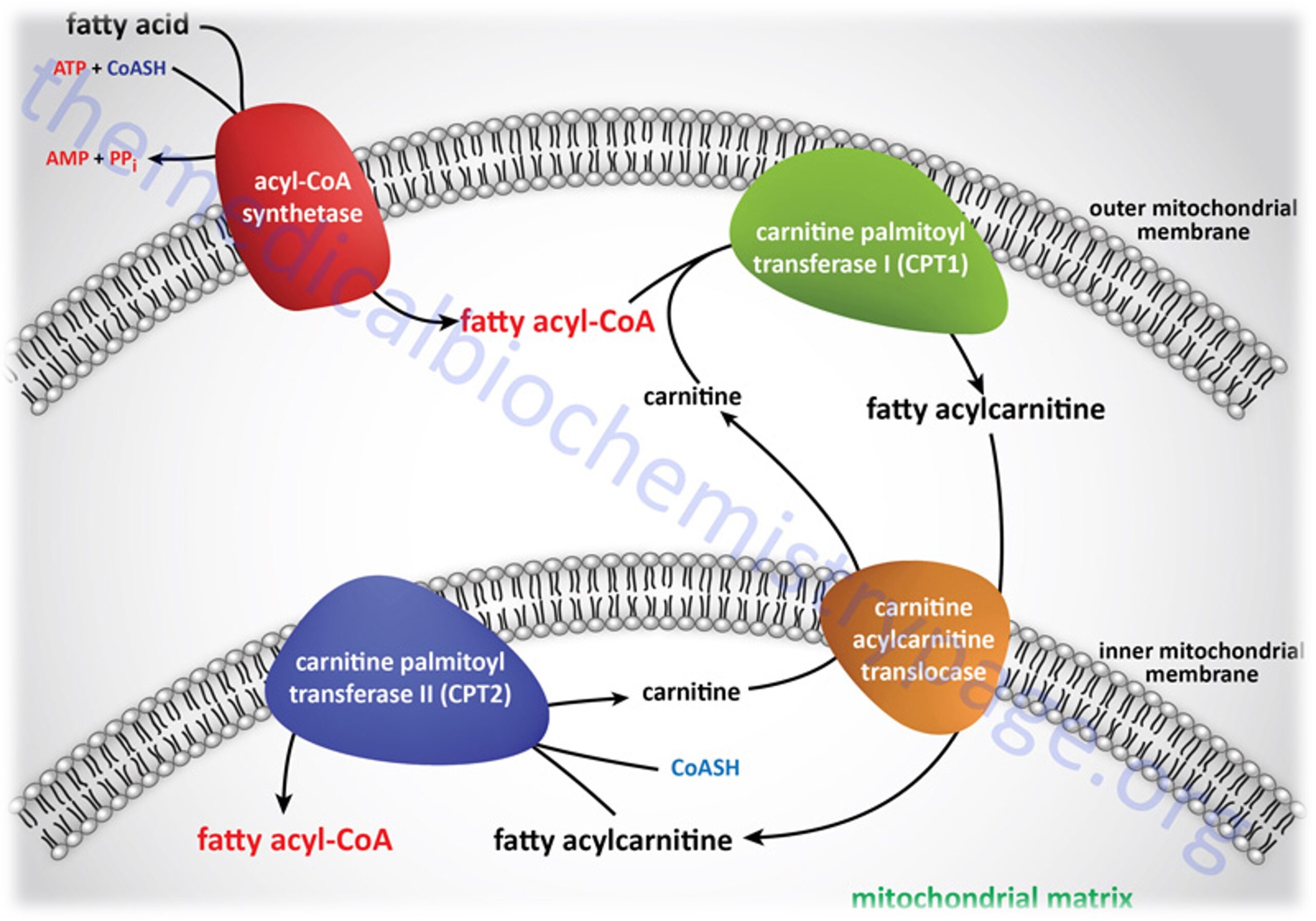
Steps of Fatty Acid Transport
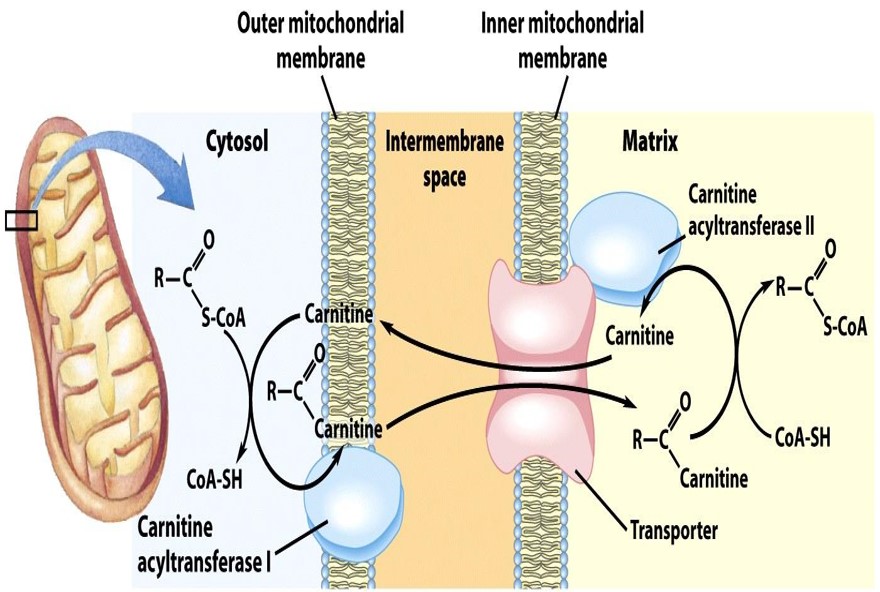
A specialized transport mechanism is required to carry long-chain acyl-CoA molecules across the inner mitochondrial membrane.
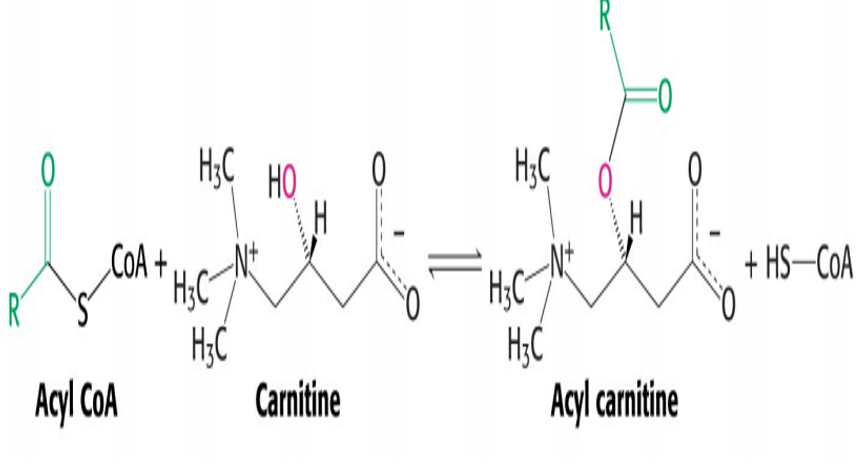
Formation of Acyl Carnitine
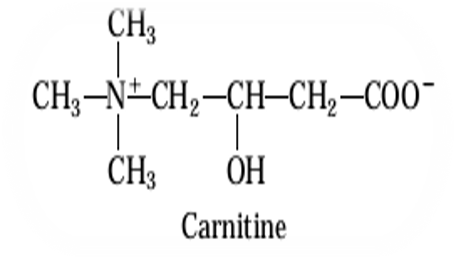
- Activated long-chain fatty acids are transported across the membrane by conjugating them to carnitine, a zwitterionic alcohol.
- The acyl group is transferred from the sulfur atom of CoA to the hydroxyl group of carnitine, forming acylcarnitine.
- This reaction is catalyzed by carnitine acyltransferase I.
- Fatty acyl-carnitine is carried across the inner mitochondrial membrane by a specific transporter.
Formation of fatty acyl-CoA with free carnitine
- The fatty acyl group is enzymatically transferred from carnitine to intramitochondrial coenzyme A by carnitine acyltransferase II.
- Regenerates fatty acyl-CoA and releases it, along with free carnitine, into the matrix.
- Carnitine re-enters the space between the inner and outer mitochondrial membranes via a transporter.
Cytosolic and mitochondrial pools of coenzyme A
- Cytosolic and mitochondrial pools of coenzyme A, which have different functions.
- The mitochondrial pool of coenzyme A is largely used in the oxidative degradation of pyruvate, fatty acids, and some amino acids.
- The cytosolic pool of coenzyme A is used in the biosynthesis of fatty acids.
Carnitine Regulation
- This carnitine shuttle is a rate-limiting step in the oxidation of fatty acids in the mitochondria, and thus fatty acid oxidation can be regulated at this step.
- Malonyl CoA, an intermediate of fatty acid synthesis present in the cytosol, is an inhibitor of carnitine acyltransferase I.
Importance
- Carnitine plays a crucial role in the transport of fatty acids across the mitochondrial membrane and thus gains access to the enzymes for the breakdown of long-chain fatty acids.
- Thus, deficiency of carnitine can lead to decreased ability of the tissue to utilize long-chain fatty acids as energy.
Carnitine Transporter Deficiency
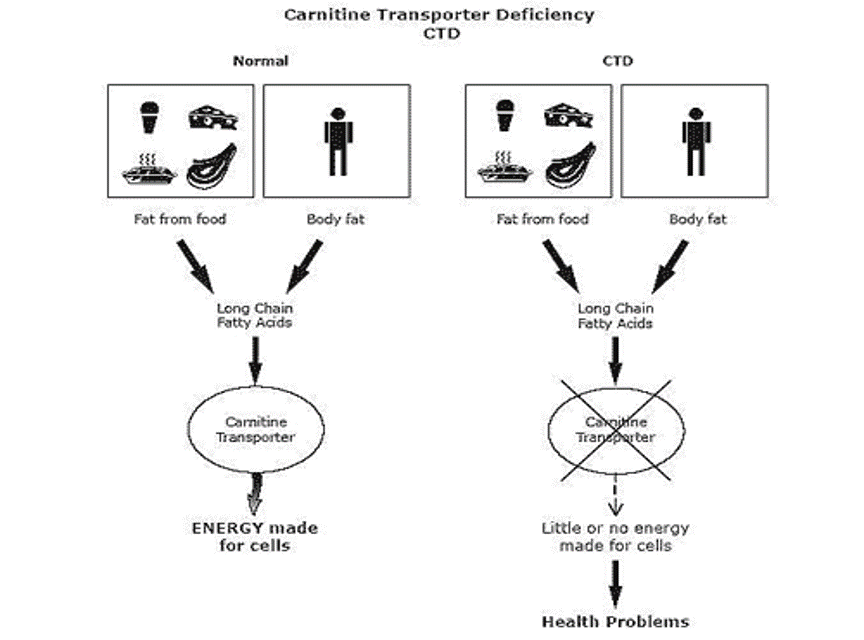
- It is one type of fatty acid oxidation disorder.
- People with CTD have problems using fat as a source of energy for the body.
- CTD occurs when an enzyme, called the “carnitine transporter” (CT), is either missing or not working properly.
- This enzyme’s job is to carry a substance called carnitine into our cells.
- Carnitine helps the body make energy from the fat in food.
- Characterized by progressive muscular weakness and aching muscle cramps.
- The symptoms were aggravated by fasting, exercise, and a high-fat diet.
Conclusion
The inner mitochondrial membrane is impermeable to fatty acids, and a specialized transport system operates to activate fatty acids from cytosol to mitochondria & peroxisomes.
